Label Artwork Guidelines Cost Guide: What Changes Price, MOQ and Lead Time
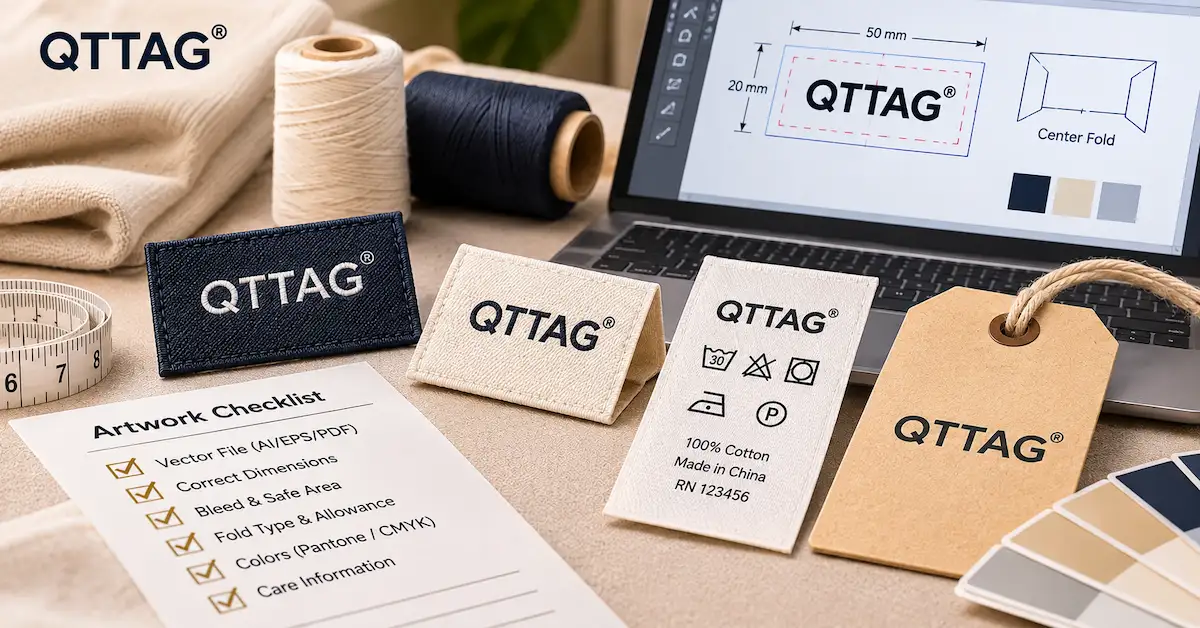
A clothing brand sends its logo to a label manufacturer. The design looks fine on screen, but the supplier asks for a different file before confirming production.
The logo is a small PNG. The intended label has a center fold, but the artwork doesn't show the folding allowance. Two care-label versions have almost identical file names, and nobody has confirmed which one belongs to the new garment.
None of these issues necessarily changes the brand's design. They can, however, change how much preparation is needed before the labels can be manufactured.
Label artwork guidelines affect production cost, MOQ and lead time by defining whether a design is ready for manufacturing. Missing files, unclear dimensions, unsuitable artwork, incorrect label information and repeated proof revisions may introduce additional preparation work. MOQ is usually driven by the label construction and production arrangements, but the number of artwork versions can change how those minimums are applied.
For apparel buyers, a production-ready file should do more than look attractive. It should tell the manufacturer what to make, how the finished label should be constructed and which information has been approved.
This guide explains where artwork-related costs come from, how to manage different label versions and what to check before releasing a bulk order.
1. What Makes Label Artwork Production-Ready?
A production-ready file is a design package that gives the manufacturer enough information to prepare the agreed product without guessing about essential details.
The exact requirements depend on the label.
A woven neck label needs an approved logo, finished dimensions, yarn colors, weaving requirements and fold information.
A printed care label needs accurate content, a printable layout, material specifications and clear instructions for cutting or folding.
A heat transfer design may require additional information about its intended size, garment fabric, placement and application.
The same artwork file won't necessarily be suitable for all three.
| Label Type | Critical Artwork Information | Common Production Concern |
|---|---|---|
| Woven brand label | Logo, finished dimensions, yarn colors, fold | Small detail and weave feasibility |
| Printed brand label | Vector artwork, colors, substrate, cut line | Print clarity and finishing |
| Printed care label | Approved text, symbols, material, versions | Information accuracy and readability |
| Heat transfer label | Logo, dimensions, fabric, application | Reproduction and compatibility |
| Paper hang tag | Artwork, bleed, die line, hole position | Cutting, printing and assembly |
| QR / barcode label | Correct encoded data, size, placement | Scanning performance |
| RFID-enabled tag | Printed design, inlay, encoding reference | Physical and electronic compatibility |
A useful distinction is that print-ready doesn't always mean production-approved.
A supplier may receive technically acceptable artwork while still waiting for confirmation of material, color or garment information.
Likewise, a digital proof can be approved visually even though physical sampling remains necessary.
Buyers should clarify which approvals are required before production starts.
2. How Can Artwork Preparation Increase Label Costs?
Artwork preparation can be a separate service from manufacturing.
Some suppliers include basic prepress checks or limited artwork adjustments in their quotations. Others charge for additional design work, file rebuilding or substantial revisions.
The difference depends on the supplier's commercial policy.
One manufacturer's publicly available artwork preparation guide identifies missing bleed, incorrect dimensions, font problems and unsuitable files as reasons artwork may require paid corrections before production.
That doesn't mean every supplier charges the same fee.
It illustrates why buyers should ask what the quoted price includes.
Vector Artwork vs. Low-Resolution Images
A vector file describes graphic shapes mathematically. It can usually be resized without the same loss of edge definition associated with raster images.
This is useful for logos, lettering and other designs that require clean reproduction.
A PNG or JPEG may be adequate as a visual reference, but it is not always suitable as the final manufacturing file.
If a supplier has to recreate an intricate logo from a low-resolution screenshot, that work may introduce preparation costs.
Buyers should provide an approved vector source when available.
Font Problems
A label layout might use a particular brand typeface.
If the production team doesn't have access to that font, the file may display differently when opened.
Characters can shift, line breaks may change and the finished artwork may no longer match the approved design.
Some manufacturers ask buyers to convert fonts to outlines. Others accept the necessary font or linked resources when properly supplied.
A sensible workflow is to retain an editable master file while providing the production version requested by the manufacturer.
Avoid treating one file format as universally suitable for every supplier.
Missing Images and Linked Assets
Some design applications link to external image files.
When the artwork is transferred to another computer, those images may be missing.
A production package should include the required linked assets or embed them according to the supplier's instructions.
The buyer should also check whether photographs have adequate resolution at their final printed size.
Upscaling a small image does not automatically restore the missing original detail.
Unclear Color Specifications
A design created in RGB for screen display may need different preparation for a print process using CMYK or spot colors.
Physical color reproduction also depends on the substrate and manufacturing method.
Woven labels introduce another consideration: yarn colors are selected from physical material options rather than reproduced exactly like digital screen colors.
An artwork file should identify important brand colors clearly.
Where color consistency matters, request a physical reference or suitable color approval process.
3. Why Bleed, Safe Areas and Cutting Lines Matter
A printed label may be perfectly designed yet produce unwanted white edges after cutting.
This often happens when background colors stop exactly at the finished trim line.
Printing and cutting processes involve practical tolerances.
Bleed extends artwork beyond the intended cut line to reduce the risk of an unprinted border appearing after finishing.
The safe area keeps important text and graphic details away from the cut edge.
How Much Bleed Should You Add?
There is no single dimension that applies to every label manufacturer or printing process.
Label Aid's artwork guidelines and Minnesota Label's preparation guide illustrate this: they publish different bleed and safe-area specifications for their respective production arrangements.
Those values are supplier-specific instructions, not universal requirements.
Before preparing the final artwork, request the manufacturer's template.
What Is a Die Line?
A die line shows the intended cutting shape.
For a rectangular label, this may be relatively straightforward.
A custom paper hang tag with rounded corners, a shaped outline or a hanging hole requires more detailed information.
The cutting path should be clearly identified in the production file.
Where the supplier requests separate named layers, keep cutting and printing information separate.
This reduces ambiguity when the artwork is prepared for manufacturing.
Why Position Matters
A hang tag design may contain an attractive logo near its top edge.
If the hanging hole has not been included in the layout, punching the tag could interfere with the artwork.
The same issue arises when text or a barcode is positioned too close to the cut line.
A digital mockup without production guides may hide these problems.
Request a proof that shows the finished dimensions, cutting shape, hole position and appropriate safety margins.
4. Label Dimensions and Fold Allowances Affect the Finished Product
A common source of confusion is the difference between a label's visible dimensions and its flat manufacturing dimensions.
Consider a woven neck label intended for center-fold construction.
The logo may occupy one visible face, but the material must provide enough length for the fold and intended attachment.
If the buyer sends only the visible artwork dimensions, the manufacturer may need to clarify how the label should be constructed.
Center Fold Labels
A center fold divides the label into two sections.
The artwork needs to be positioned according to the finished orientation.
If both sides contain information, the layout must account for what will remain visible after the fold and sewing process.
End Fold Labels
End-fold labels have material folded behind the visible area.
The supplier needs to know whether the specified width includes or excludes the folded allowances.
The exact requirement depends on the selected construction.
Straight Cut Labels
Straight-cut constructions may require less folding work, but edge finishing still matters.
A cut edge should be suitable for the material and intended garment application.
Sewn Label Placement
A label intended for a garment seam has different attachment requirements from one sewn flat onto fabric.
Before quoting a design, the supplier should know how the label will be used.
For a production manager, a finished label sample is more valuable than a flat artwork preview when confirming dimensions and attachment.
5. Woven Label Artwork: When Is a Logo Too Detailed?
Woven artwork has physical manufacturing limits.
The design is produced using yarns, not the same pixel-based process used by a digital screen.
Small lettering, narrow lines and closely spaced shapes may need review before the manufacturer can reproduce them clearly.
A large digital preview can make an intricate logo look straightforward.
At a finished label width of only a few centimetres, the same artwork may require adjustments.
Artwork Complexity
The supplier may need to assess letter spacing, line thickness, color boundaries and weave construction.
These considerations are particularly relevant for intricate wordmarks.
A manufacturer might recommend a different weave, an adjusted label size or modified production artwork.
Such recommendations should be reviewed by the brand before sampling.
Artwork Revisions and Cost
A design that requires several development attempts can introduce additional preparation or sampling work.
The actual charges depend on the supplier's policy.
It is therefore useful to obtain a technical review before confirming the bulk production price.
High-Density Weaving
High-density woven construction may be considered for relatively detailed designs.
However, selecting it does not guarantee that every small letter will be reproduced clearly.
The physical result depends on the artwork, yarn and weaving specification.
A buyer should compare samples at the intended finished size.
Approve Physical Yarn Colors
Digital color references provide a useful starting point.
They do not fully demonstrate how the finished yarns will appear under ordinary lighting.
Where the brand requires a specific color appearance, use the supplier's approved physical samples or yarn references.
This is particularly useful for repeat orders.
6. Printed Care Labels Need More Than Correct Artwork
A printed care label can have technically perfect printing while containing incorrect garment information.
For example, a supplier may reproduce a fiber composition exactly as provided.
If the clothing manufacturer later changes the garment fabric, the original care-label artwork may no longer be accurate.
The problem is not necessarily a printing defect.
It may be a failure in the content-approval process.
Who Approves Care-Label Information?
The responsible product or compliance team should establish the garment's correct information and review applicable destination-market requirements.
The label manufacturer should receive approved content.
Care instructions should not be invented from photographs or copied from unrelated garments.
U.S. Labeling Requirements
For covered textile products sold in the United States, the Federal Trade Commission's Textile Fiber Rule addresses disclosures including fiber composition, business identification and origin information.
The FTC's Care Labeling Rule separately regulates care information for covered products.
The required content and presentation depend on the actual product and relevant rules.
Buyers should not assume that an artwork template approved for one country is suitable for every export market.
Multilingual Care Labels
An international clothing brand may require care information in different languages.
A small care label can become crowded when multiple language versions are added.
The buyer may need to consider a longer layout or a suitable multi-panel construction.
However, the final text still needs to remain readable.
Using a smaller font simply to fit more information can create new problems.
Artwork Version Control
The manufacturer should be able to distinguish between care-label versions belonging to different garments.
An accurate design file is not useful if it is associated with the wrong product.
This is why product identifiers, approved text and revision numbers are important.
7. How Do Artwork Variations Affect MOQ?
MOQ stands for Minimum Order Quantity.
When ordering custom labels, buyers may focus on the total number required for a clothing collection.
The manufacturer may calculate minimums differently.
Depending on the product and supplier, MOQ can apply to each artwork, colorway, material or manufacturing run.
The number of artwork versions can therefore influence how the order is organized.
An Example: Private Label T-Shirts
Consider a clothing collection containing four sizes.
The brand uses the same logo but wants the garment size printed inside each neck label.
| Artwork Version | Planned Quantity | Difference |
|---|---|---|
| Small | 200 | Size information |
| Medium | 300 | Size information |
| Large | 300 | Size information |
| Extra Large | 200 | Size information |
| Total | 1,000 | Four artwork versions |
This is a hypothetical example, not a QTTAG ordering minimum.
The buyer needs to confirm whether the manufacturer can treat the variations as one combined commercial order or whether each design has a separate minimum.
A similar issue occurs when the same label is produced in several yarn colors.
Printed Labels vs. Woven Labels
Some printed-label production systems can accommodate selected variable artwork arrangements.
Woven labels have different manufacturing requirements because the artwork forms part of the woven construction.
That does not establish that all printed versions can share one MOQ or that woven versions always require separate minimums.
The supplier must confirm the actual production policy.
Low MOQ and Artwork Costs
A low minimum may be useful for emerging clothing brands.
But the unit price can be influenced by how development and setup work is allocated across the order.
A small production run with several complex artwork versions may involve more preparation than a large run of one approved design.
The buyer should ask whether artwork preparation, proofing and revision charges are included.
Otherwise, a low MOQ may not translate into the lowest total purchasing cost.
8. Can Better Artwork Reduce the Total Cost of Labels?
It can reduce avoidable work, but a specific saving cannot be promised without a real quotation.
Artwork errors may result in extra prepress preparation, sample revisions, reprinting or production delays.
Clear files help the supplier identify the intended product sooner.
A simple budgeting framework is:
Total label project cost = label manufacturing + applicable artwork preparation + proofing and samples + finishing + packing, freight and agreed additional services.
If the garment factory charges separately for sewing or applying the labels, that cost belongs in the complete garment budget.
What Does the Quotation Include?
A supplier may include basic artwork checks but charge for rebuilding a low-resolution logo.
Another may include a digital proof while charging separately for physical samples.
A third may offer a more complete development package.
These are different commercial arrangements.
When comparing quotations, clarify the scope.
What Happens After Proof Approval?
A buyer may approve the layout and then request changes to the text, colors or dimensions.
Depending on the stage of production, those revisions may require additional preparation or work.
The important distinction is whether the change corrects a supplier manufacturing error or modifies an already approved specification.
Those situations may have different commercial consequences.
A clear approval record can reduce misunderstandings.
The Cost of Incorrect Versions
Imagine a garment factory receiving several care-label versions.
The artwork is correct, but the labels are packed without clear SKU identification.
The factory must spend additional time sorting them or risk attaching the wrong labels to garments.
This cost may not appear on the original label quotation.
Yet it is part of the operational consequence of incomplete artwork and version management.
9. How Does Artwork Approval Affect Production Lead Time?
Production lead time is not always calculated from the first inquiry.
A supplier may begin counting after final artwork approval, sample approval or another agreed milestone.
This should be stated clearly before the purchase order is confirmed.
Artwork problems can delay the point at which manufacturing begins.
A Typical Artwork-to-Production Workflow
| Stage | What Happens | Potential Delay |
|---|---|---|
| RFQ submission | Buyer sends specifications | Missing dimensions or quantities |
| Artwork review | Supplier checks production feasibility | Unsuitable files |
| Prepress preparation | Files are prepared for manufacturing | Font, color or image problems |
| Digital proof | Buyer reviews the final layout | Slow approval or unclear revisions |
| Physical sampling | Representative labels are produced | Construction adjustments |
| Sample approval | Buyer confirms finished reference | Unresolved material or color decisions |
| Bulk scheduling | Supplier allocates production | Material or capacity availability |
| Manufacturing | Labels are woven, printed or transferred | Production-specific issues |
| Finishing | Cutting, folding or other work | Special construction requirements |
| Quality inspection | Products are checked | Incorrect versions or defects |
| Dispatch | Finished order is shipped | Packing and logistics arrangements |
Not every order requires every stage.
A straightforward repeat order may have less preparation work than a new design.
However, changes to material, artwork or label construction may require renewed approval.
When Should the Buyer Approve Artwork?
It is useful to establish internal approval responsibilities before sending the RFQ.
The brand's design team can confirm the visual identity.
The garment technical team can verify dimensions and application.
The relevant product or compliance team can approve care information.
The purchasing team can confirm quantities and delivery terms.
These responsibilities may be handled by fewer people in a small company, but the decisions still need to be made.
Production Time vs. Delivery Time
The supplier's production completion date is different from the date usable labels reach the garment factory.
Packing, shipment and any applicable import procedures can add time.
If the clothing factory needs labels before a particular sewing milestone, communicate that requirement.
A realistic schedule should identify the necessary approvals and expected delivery arrangements.
10. Smart Labels, QR Codes and RFID Require Additional Artwork Planning
Label artwork is becoming more than a printed logo or garment information panel.
Some apparel projects include retail barcodes, QR codes or RFID tags.
These applications require additional data and production checks.
Barcodes
A barcode must contain correct data and remain readable under the intended scanning conditions.
Its placement, dimensions, contrast and quiet zones matter.
A quiet zone is the clear space surrounding a barcode that helps scanning equipment recognize the symbol.
According to GS1's barcode guidance, symbol dimensions need to suit the printing method, material and application.
The correct size isn't determined solely by the designer's visual preference.
The final printed symbol should be verified using an appropriate process.
QR Codes
A QR code may direct customers to a product page, care information, authenticity service or other relevant digital content.
Its visual design is only one part of the requirement.
The encoded destination needs to be correct and available.
If a QR code points to a temporary or incorrectly configured webpage, printing it accurately will not solve the problem.
For product-identification applications, GS1 Digital Link provides a standards-based way to connect suitable product identifiers to digital resources.
A brand considering this approach should first establish its product data and intended use.
RFID Labels
An RFID-enabled label may include an electronic inlay as well as printed artwork.
The inlay's size, construction, placement and intended encoding require separate technical review.
A design file alone cannot establish RFID reading performance.
The appropriate solution depends on the garment, tag construction and intended operating environment.
Manufacturers such as Avery Dennison offer RFID inlays developed for apparel applications, illustrating that electronic tag selection is a separate engineering decision from the visible graphic design.
Artwork and Data Must Agree
A smart label may contain both human-readable information and electronically or optically encoded data.
Those elements need to refer to the correct product.
The buyer should establish how identifiers are generated, assigned, approved and checked.
QTTAG's availability of specific RFID, NFC or advanced smart-label constructions must be confirmed for the individual project.
11. Sample Approval: What Should Buyers Inspect?
A digital proof confirms parts of the design, but it doesn't demonstrate every physical characteristic of the finished label.
A woven label may have a different texture from its screen preview.
A printed label may appear different on its actual substrate.
A heat transfer may need to be tested after application to garment fabric.
The sample should therefore represent the intended construction.
Artwork and Information
Check logo proportions, text, symbols, color references and any variable product details.
For care labels, confirm that the content matches the actual garment.
Dimensions and Finishing
Review finished width and height, cut edges, folds and sewing allowances.
For paper tags, check the hole position and cutting shape.
Material and Appearance
Evaluate yarns, substrates, printing and texture.
If the approved material differs from the sample material, document that difference.
Garment Application
Where practical, evaluate the label on a representative garment.
A loose sample may not reveal problems caused by attachment or placement.
Barcode and Smart-Label Functions
Check printed code readability and encoded data.
For RFID applications, the electronic tag should be evaluated according to the intended product and operating conditions.
Keep the Approved Reference
Once the sample is accepted, retain the physical product and corresponding artwork version.
This becomes the reference for manufacturing and later repeat orders.
A supplier cannot reliably reproduce an approved product if the critical specification has not been recorded.
12. A Production-Ready Artwork Checklist for Apparel Brands
Before submitting artwork for a custom label order, check the complete package.
| Item | What Buyers Should Confirm |
|---|---|
| Master artwork | Correct, approved brand logo |
| File format | Accepted by the manufacturer |
| Editable source | Available where required |
| Fonts | Outlined or supplied according to requirements |
| Images | Suitable resolution at final size |
| Colors | Approved process, spot or yarn references |
| Dimensions | Clearly identified finished size |
| Bleed and safe area | Based on the supplier's template |
| Cutting path | Correctly identified where required |
| Fold type | Finished construction and allowances |
| Material | Approved substrate, yarn or transfer system |
| Care information | Verified for the relevant garment and market |
| Barcode / QR | Correct data, placement and readability |
| RFID | Inlay and encoding requirements where applicable |
| Artwork versions | Clear SKU and revision references |
| Quantity | Amount required for each version |
| Sample approval | Defined review and acceptance process |
| Delivery | Required arrival date and destination |
Not every project needs every item.
For example, a straightforward woven wordmark will not require a retail barcode specification if no barcode is included.
The purpose of the checklist is to identify the requirements that apply, rather than adding unnecessary preparation work.
13. How Can Brands Reduce Artwork Revisions?
Most useful improvements happen before the supplier receives the files.
Establish One Approved Source
Keep one master logo and a clear system for identifying approved versions.
Avoid circulating several competing files without explaining which one is current.
Separate Design Approval From Technical Approval
A logo may be approved aesthetically while its size, material or construction remains unresolved.
Both decisions should be clear before bulk production.
Use Meaningful File Names
A file named final-new-v3-revised.pdf provides little information about which garment it belongs to.
A better naming system identifies the product, design and revision.
For example:
brand-neck-label-style-a-rev03.pdf
This is an illustrative naming convention, not a required QTTAG file format.
Keep an Artwork Change Log
Record which details were changed and who approved them.
For a multi-SKU order, this reduces confusion when several versions are in development.
Limit Unnecessary Revisions
A brand may request changes for legitimate reasons.
But repeated minor alterations after artwork approval can interrupt preparation or require renewed samples.
Review the complete design and garment information internally before giving final approval.
Ask for the Supplier's Technical Template
Different manufacturers have different preparation requirements.
Using the correct template early can reduce the need to rebuild finished artwork later.
14. What Should You Send to a Label Manufacturer for an Accurate Quote?
An accurate quotation needs a description of the finished product, not just an image file.
| RFQ Information | What to Provide |
|---|---|
| Label type | Woven, printed, care, heat transfer or smart label |
| Garment type | Intended apparel application |
| Artwork | Approved design and source files |
| Finished size | Width, height and relevant construction |
| Materials | Preferred yarn, substrate or transfer system |
| Colors | Approved brand references |
| Finishing | Cutting, folding or attachment requirements |
| Artwork versions | Number of designs and product associations |
| Quantity | Total and per-version requirements |
| Variable data | Sizes, fiber content, product codes or languages |
| Smart-label needs | Barcode, QR or RFID requirements |
| Sampling | Digital and physical approval needs |
| Quality requirements | Relevant readability, appearance and performance |
| Commercial scope | Artwork charges, setup, finishing and packing |
| Delivery | Destination and required arrival date |
If the artwork is incomplete, tell the supplier what is missing.
A manufacturer may be able to offer artwork preparation services, but the scope and charges should be agreed before the work begins.
The buyer should also confirm whether the quotation applies to the proposed production-ready file or is only an estimate based on the supplied reference.
15. Frequently Asked Questions About Label Artwork Guidelines
What are label artwork guidelines?
Label artwork guidelines define the file, layout, dimension, color, technical and information requirements a manufacturer needs to prepare labels for production.
Why can incorrect artwork increase production cost?
Files that need rebuilding, font correction, color preparation or other adjustments may require additional work. Charges depend on the supplier's services and quotation terms.
Is a PNG file suitable for custom woven labels?
A PNG may be useful as a reference, but a manufacturer may prefer editable vector artwork and defined specifications. The correct format depends on the product and supplier.
What file format should I send for printed labels?
Many manufacturers accept suitable vector or print-ready formats. Ask the supplier for its preferred file type and any requirements for fonts, linked images and color settings.
Does every printed label need bleed?
Bleed is relevant when artwork extends to a cut edge. The required amount depends on the supplier's production process and template.
How do artwork versions affect MOQ?
Different designs, colorways, materials or information versions may be treated as separate production items. Whether quantities can be combined depends on the manufacturer.
Can one label artwork file be used for several clothing sizes?
Sometimes, particularly when the physical label is identical. If printed or woven information changes by size, separate approved versions or controlled variable-data production may be needed.
Who is responsible for care-label information?
The business responsible for the product must ensure that the required information is accurate and meets applicable regulations. The printing supplier should receive approved content.
Can a QR code be added to a clothing label?
Yes, when the label construction supports it. Code dimensions, encoded information, placement, durability and scanning performance need review.
Do RFID labels require special artwork?
RFID-enabled products need additional inlay, encoding and application specifications. Visible artwork alone is not enough to approve the electronic component.
How long does label artwork approval take?
There is no universal timeframe. It depends on the completeness of the files, technical review, required revisions and the buyer's approval process.
Is a digital proof enough for bulk production?
It may be sufficient for some limited artwork checks, but new materials or constructions can require physical sampling and other performance evaluations.
Can suppliers charge for repeated artwork revisions?
Some do. The terms depend on what is included in the initial quotation and when revisions occur. Confirm the policy before approving development work.
How can I avoid wrong labels being delivered for different SKUs?
Use clear version identifiers, approved product information, separate quantity records and suitable production and packing inspections.
What should be approved before placing a bulk label order?
Confirm the artwork, content, construction, material, dimensions, version quantities, sample requirements, pricing scope and production schedule.
16. Prepare Production-Ready Label Artwork With QTTAG
A reliable label order starts with an approved design and a clear manufacturing specification.
The artwork should communicate what needs to be produced, but garment information, material requirements and production arrangements must also be confirmed.
QTTAG supports custom apparel branding inquiries involving woven labels, printed care labels, heat transfer labels, hang tags and related garment identification products.
Specific printing, smart-label, barcode or RFID capabilities should be confirmed for each project.
Ready to Prepare Custom Labels for Your Clothing Brand?
Share your approved logo artwork, garment specifications, label dimensions, preferred materials, printing or weaving requirements, artwork versions, estimated order quantity and delivery needs with QTTAG.
Our team can review your requirements and discuss available customization, sampling and quotation options.
Request a Quote
Author
Founder at QTTAG
Jason Qiao is the founder of QTTAG, focusing on garment branding and packaging solutions. With years of experience in the apparel industry, he shares practical insights on custom labels, hang tags and sustainable packaging to help global brands grow.
Written By
Jason Qiao